Pennsylvania Fiddling
We can study and deduce many things about the past,
but it helps if there are physical artifacts that give us information to base
our conclusions. Do you ever wonder what music in America sounded like over 100
years ago? Much of what we know about music that predates recording technology
comes from written sheet music, but what about all the music that was never
written down?
Like many ethnic cultures around the world, Old Time
Appalachian fiddling has a long-standing tradition of being taught and learned
aurally, or by ear. We may think of this approach as out-dated and inferior,
but this is due to the large emphasis our modern culture has placed on reading
and writing in our education. In the absence of books, many of the early
Appalachian inhabitants had an extremely well developed attention span and
memory out of necessity. It was commonplace for someone to perfectly recite a
ballad over twenty verses long after hearing it only one time. Also, there was
a great deal of attention paid to who the tune was learned from, and what the
circumstances were, tracing it’s path back for generations so that the song
itself has a living history with many contributors acknowledged going back to
the Civil War and earlier. Many thousands of songs, tunes and dances were
preserved through time this way, even as people migrated across the country.
When radio and recordings became available, the old traditional method started
to fail, as younger generations now had a much easier way to hear music, and
had access to music from regions outside their community as well. It is sad,
but as technology brings progress, it can also take away the need to realize
the full potential of your abilities.
Some music historians, or ethnomusicologists, have
dedicated their lives to study and preserve as much of the rural folk music
they can find, before the aural tradition disappears completely. In the 1920’s
a Penn State professor named Sam Bayard took an interest in Pennsylvania
fiddle music. Dr. Bayard was an English professor, but he loved music as a
hobby, especially the music of the British Isles. He had hoped to spend time
traveling around Ireland and England studying old tunes there, but when his
travel plans fell through, he found that there was just as much to be learned
from fiddlers right here in Pennsylvania. During his summer vacations between
1928 and 1963 he traveled around Southwestern Pennsylvania looking for fiddlers
and fife players to collect their tunes. These tunes had never been written
down before, but Sam had the amazing ability to write them into sheet music by
hand as they were being played (slowly I suppose.) Later when tape recorders
became available he also recorded many of the old fiddlers, and some of these
recordings are still available. When he was done, Sam had collected 600 tunes
from over a hundred different fiddlers, and the collection was eventually
published in 1982 titled Dance To The Fiddle, March To The Fife.
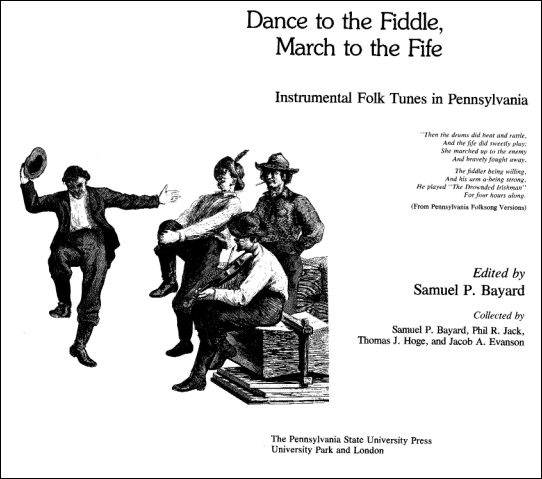
This is an invaluable
resource because it captured something before it vanished entirely, the living
tradition that the people of this area maintained for all the generations that
brought their families to America, through all that has happened until now. Sam
didn’t include much of the history of these people in his book, but he made a
lot of comparisons between the tunes he found in America to tunes collected in
books from long ago, and could draw some conclusions from them. One of the
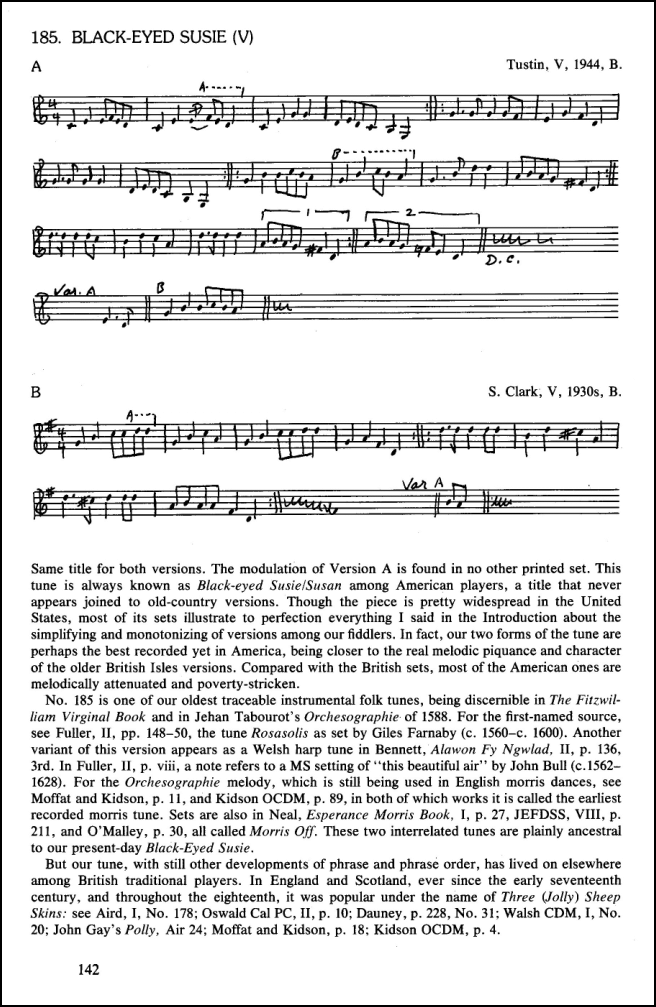
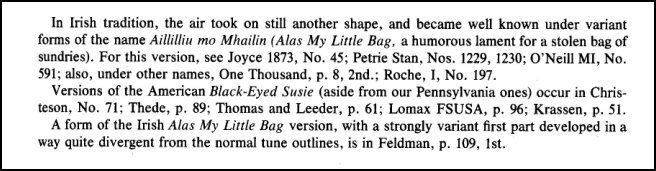
tunes he included was call Black Eyed Susie, (clicking
on this link will play my rendition). Sam found that this tune, as it was
played by Pa. Fiddler John Tustin from Greene county, compares closely
with tunes found in books of old English fiddling dating back to 1588. Here is
a copy of that page from his book.
Some of the tunes in the
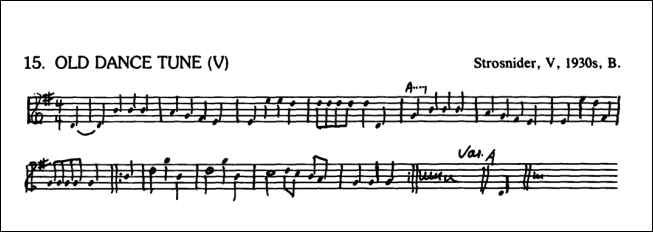
book lack a distinctive title, and are listed as Old Dance Tune, or Old Reel...
etc. Most likely this is because the fiddler may have forgotten the real name,
or perhaps never knew it.
This tune is from a fiddler named George Strosnider,
from Waynesburg, Greene County, who was born in 1859. I have renamed it Strosnider’s Polka , just
to keep it apart from any other tunes named this way,
(clicking on this link will play my rendition).
While this book has the appearance of being written
in order to satisfy other music scholars (and no doubt publishers), I believe
Sam Bayard truly had a great love for the music of this region. Despite its
plainness and simplicity, folk music deserves every bit as much importance and
recognition as any other style. Its preservation should not be entirely
dependant on commercial success, popularity through mass media, or promotion
through higher education.
Unfortunately, Dance To The Fiddle, March To
The Fife is out of print, and used copies go for up to $300. However,
an earlier, smaller book published by Bayard in 1944 called Hill Country Tunes
can be viewed online at the Penn State website.